Welsh Legends & Myths Book Review
Lulu Press Inc, 2018
ISBN 10-1291985271
284 pp, paperback
After scouring hundreds of Welsh legends and myths, author Graham Watkins has come up with 80 of what he considers the best and most interesting.
The 80 legends come from different locales in Wales. The cast of characters includes a lot of kings and king wannabes, a lot of kings’ daughters looking for love, a lot of paupers looking for kings’ beautiful daughters (hint: they’ll need a lot of money), with some barons, travelers, ghosts, mermaids and ordinary folks mixed in.

Back Cover
Although the chapters are all short, this is not exactly a book for children, like an Aesop’s Fables would be. There are plenty of head choppings, vengeful ghosts, rapes, adultery, and dismembered bodies to go around. There is a lot of hardship in the book, which reflects the hard lives and violent past of the people of Wales.
If you are expecting morals to the story, you can forget about those, too. One story was little more than “quintuplets boys were born, they went on a journey and all of them died.”
The first thing to get used to is Welsh names and words. Chapter titles include Tylwyth Teg, Y Bugail Unig, The Ogre of Abergavenny, and The Gwiber of Penmachno.
A lot of entertaining Welsh history can be learned from this book, although it is at times difficult for the reader to differentiate between actual myth and actual history. A reader might think a story is complete myth, then find that the castle, for example, mentioned in the story is an actual castle that is still standing, and the protagonist was an actual historical figure.
One of the more thought-provoking stories is about Prince Madoc, a Welsh explorer, who is believed by some to have landed on America’s East Coast in the year 1170. Then, in 1608, an explorer named Peter Wynne is said to have discovered an Indian tribe in Virginia calling themselves Monacan Indians, a tribe which Wynne claims spoke “Welch.”
Further research shows that in an 1804 letter, then U.S. President Thomas Jefferson wrote of searching for Welsh Indians, “said to be up the Missouri (River).”
Interestingly, in the introduction, the author mentions his “licence to embroider.” He writes, “I admit that I had a lot of fun adding my own interpretation to some of the tales.” In other words, he has changed some of the stories from more original versions.
This book was previously published in five volumes and named Legends and Myths from Wales.
If you are a “Cambrophile” and already well-versed in Wales and its history and culture, you will almost certainly enjoy this book. If you are a complete Wales neophyte, you can enjoy this book if you have an open mind.

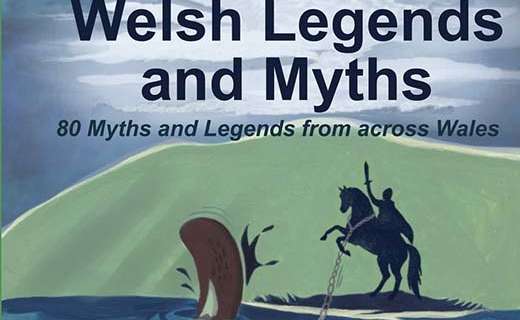
Front Cover
Marshall Hughes
Buy this book from Amazon USA | UK | Japan
Read more reviews of books on Britain and Books on Cornwall.